How the Colorful Kue Lapis Evolved to Become Sarawaks Geometric Kuih
From Indonesia to Suriname – The Story of the Kue Lapis
Kue Lapis, Lapis Legit and Kek Lapis Sarawak
Indonesia’s kue lapis, kue lapis legit and Malaysia’s kek lapis Sarawak are some of the most famous kues to exist. These buttery, chewy layered cakes are such prominent icons in Indonesia, Brunei, Singapore and Malaysia. Whether you are in a hawker center, supermarket or restaurant you are bound to find these kues around in a variety of flavors and varieties. These special layered cakes have taken on many transformations in its ingredients, cooking methods and additional flavors. This was largely due to the large scale transformation the region had during European colonial invasions across the archipelago which resulted in these kues being a common snack in countries like the Netherlands and Suriname as well.

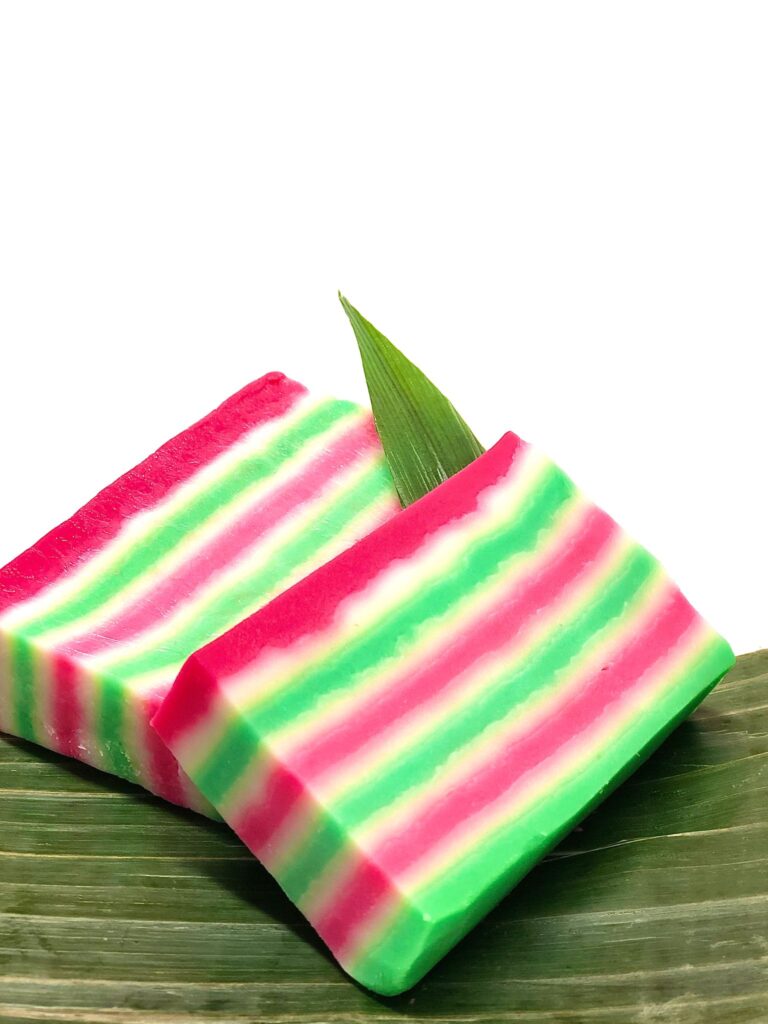
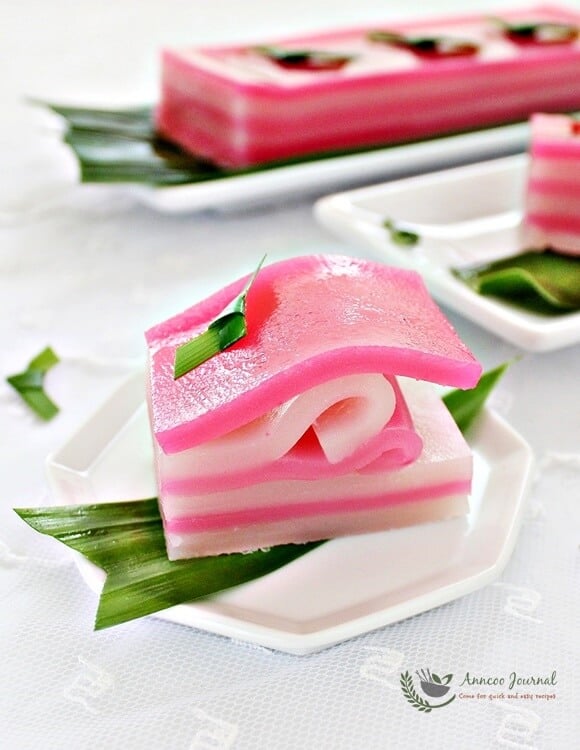
Kue Lapis
Kue lapis, also known as kuih lapis beras and kue pepe is a kue that is prepared by steaming layers of different coloured rice flour. The colors are often green, red and white. This kue originally came from the Teowchew people in Southern China around the Fujian region, where it is known as the “九层粿 nine layer cake” since each of the 9 layers are steamed one after another to create a beautifully delicate cake. These cakes are made during the Double Ninth Festival which celebrates the nineth day of the nineth month because the number 9 is a very auspicious number in Chinese culture. These treats would be shared with friends and family, as well as trading partners. So when Chinese traders would trade in Indonesia, they would share this very auspicious kue to the local population. This is why in Indonesia, they are qlwo called “Kue Lapis Cina”.
There is an auspicious Chinese saying “歩歩高升” (bu bu gao sheng ) to wish for good fortune and translates to “rising step by step”. It is said that this saying is embodied by kue lapis and the even layers represent many layers of equal prosperity,”.
The process is more straightforward than you would imagine and it involves coconut milk, rice flour, tapioca flour and a form of sweetener. Food coloring is used to decorate the kuih in whichever way is desired. The sweet treat is then steamed to create the jiggly and soft kue lapis. It is a simple treat that can go a very long way. It’s simplicity in ingredients leaves room for creative presentations. They often come in rectangular slices as well as diamond and tortoise shell shapes. But from these, you can also see some inventive designs like this one in the image.
Green is a very common color in kue lapis as you can easily create a natural green food color with pandan leaves. That’s why a popular design is to have a green ombre design over the kue. It is also the color of Islam which provides more significance to the green colour. The other popular colour is red – or pink, which can also be naturally derived from berries and flowers across the region as well as red yeast rice (whar would have been used more in China). The hibiscus, bunga raya or kembang sapatu is a vibrant red flower in South East Asia, and is the national flower of Malaysia, very fitting for kuih lapis then! Finally the white colour is simply without any colouring but I like to think of it as representing Indonesia’s national flowers, the white orchids and jasmine.
This was just a little connection I made, with the common colours reflecting the natural dyes in the region that would have been frequently relied upon. It is very fitting that the colours are green, red and white due to their significance in SE Asia’s culture. Now of course, mass food coloring is easily available in stores. As a result, today kue lapis come in an infinite number of colours and designs. The kue lapis is widely available across modern day Indonesia, Malaysia, Singapore and Brunei, as well as the Netherlands due to the colonial connection, which we will get into later.
Kue Lapis Legit
Kue lapis legit is a very similar variation on the kue lapis. It’s ingredients vary as this recipe was colonized along with the rest of the archipelago. In this case, it was the Dutch that influenced the creation of the kue lapis legit. The recipe resembles western dessert making with the batter being made up of butter, sugar, wheat flour as well as condensed milk. Similar western desserts that were being developed at the time include the German Baumkuchen which has its own journey to become a world famous buttery layer cake. However, the kue lapis legit does not hold a strong connection to the history of the Baumkuchen aside from the layers. The timeline just would not align since the Baumkuchen only rose in popularity in the 1700s while layer cakes in east Asia has been a tradition for many centuries before. Many assume it came from a specific western cake but this is false and instead is a western-Asian fusion of the Chinese layered cakes.
A key distinction this kue has from the Western desserts is that it also includes spices such as cinnamon, cloves, nutmeg, mace and cardamom which produce its distinct sweet, yet warm taste. Cardamom has been cultivated in western Indonesia for millenia. Nutmeg, mace and cloves originally come from the molukas islands of Indonesia and was the root cause of such ferocious colonial interest, leading to devastating wars, genocides and attacks over control of these islands. It was these very spices, which only grew on a select few islands which were the catalyst for the European Spice wars, uprooting the entire archipelago and altering the entire ecosystem and population.
The aforementioned spices have a variety of uses in South East Asian culture and it is no surprise that they would be used in this kue as well. The cinnamon originates from Sri Lanka and has been traded across Asia for millenia. Later, the Dutch had trading posts in Sri Lanka and even tried growing cinnamon in Indonesia in the 1800s, but they were less successful than the Sri Lankan varieties. Nonetheless, the cinnamon was another common ingredient in 1600s SE Asian cooking. These extra ingredients, while a great additiotn, were not the biggest change from the original kue lapis.
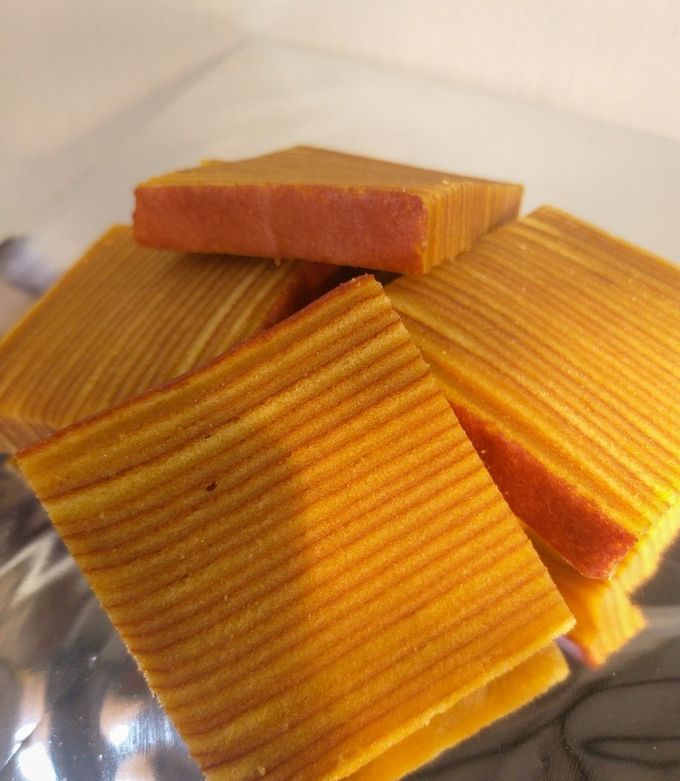
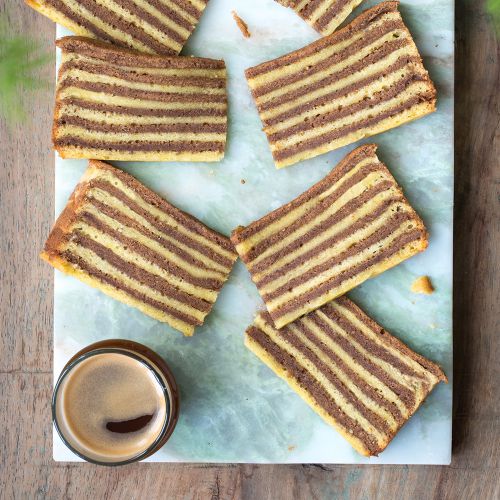
The main difference in how it’s prepared is that it’s broiled in an oven as opposed to steamed. While it seems a straightforward change, the cooking process is a lot more laborious. When steaming, you can steam the whole kue at once, without the layers interfering. However, when broiled/baked, you have to individually bake every single layer, one by one, ensuring the oven stays at the right temperature to cook the top layer without burning and without drying out the rest of the cake underneath. This takes lots of patience and a real understanding of your oven. Some lapis legit can have up to 50 completely uniform layers! So who was doing all this work to make these tasty treats?
When the Dutch colonizers controlled Batavia, they married Indonesian women starting what would become the “Indo” people who were of mixed heritage. It is said that the wives would prepare lapis legit using baking methods used to create familiar Western cakes for their husbands but with adapted Indonesian recipes, in this case, the kue lapis was adapted. This was a very laborious task and really highlights the skill of the bakers to perfectly cook each layer and produce a beautiful looking and tasty treat. They combined the western ingredients with the spices and baking ingredients of their Indonesian heritage to create a new dish, the kue lapis legit.
Typically, lapis legit relies on the spices to color the cake, each layer being beige with a browned top and bottom. The brown accentuates the distinct layers of the cake, creating a beautiful pattern and a beautiful warm flavor. Further variations to the flavor in Indonesia include pandan, cheese and prune flavor as cooks get more experimental reinventing the dish.
The Dutch took a strong liking to the cake as well and called it Spekkoek, literally meaning “bacon cake” as the layers resemble thin cuts of bacon… supposedly. Also, the version found in the Netherlands and Suriname has fewer and thicker layers which essentially means they removed a lot of the difficulty from the original process, once again simplifying another culture’s dish for their simpler, more bland palette. The idea of the thin layers representing how everyone will get equal amounts of good fortune has been changed to a few layers of good fortune to the lucky few… It is a sad to see the meaning of the layers get stripped away as it became to difficult to reproduce on a larger scale.
Due to colonialism, the spekkoek is also popular in Suriname, a previous Dutch colony. As spices were torn from their native islands by the Europeans, cakes with such rich spices could be made anywhere. So soon enough, once the Dutch claimed the Spekkoek into their palette, it made it’s way to the other colonies like Suriname where it is still eaten and enjoyed today. In Suriname, the kue lapis is simple known as “lapis”. The common red, green and white of the kue suit Suriname well as it is the same colors of the flag! You will find that the flavor of kue lapis and lapis legit do not compare to those made in SE Asia though as they are made with authentic, fresh ingredients.
Kuih Lapis in Malaysia
The Kue Lapis (spelled kuih lapis in Malay) became a staple in Malaysia just as it did in Indonesia with both regions using similar cooking methods, ingredients and pallets. Before European colonialism, the specific countries of Indonesia and Malaysia did not really exist, but instead a variety of different kingdoms and empires that spanned the archipelago, trading and sharing knowledge passed down through generations. Hence why kue lapis is also a culturally significance kuih in Malaysia. As the baked version became popular during colonial rule, Malaysia went a different direction in what flavors they used.
Both the kue lapis and lapis legit quickly grew in popularity across the entire archipelago including modern day Malaysia and Singapore which has resulted in this dish being an icon of Malaysian and Singaporean cuisine as well. However, Malaysia were keen to have a kue lapis to call their own, and in the 1980s, cooks in Sarawak, Malaysia took it to the next level.
The Kek Lapis Sarawak is the crazy best friend of Indonesia’s more traditional version. While you may see some flavors like prune flavor in Indonesia, Sarawak is home to the most colorful bakeries in the world with kek lapis shops selling vibrant, colorful kuih in a plethora of inventive flavors. These include mint, walnut cheese, Horlicks, jasmine Oreo, apple and watermelon, mocha, matcha, haw flakes and seri kaya flavor just to name a few. The flavors are added into the batter or mixed in as chunks like fruit pieces, biscuits and anything a baker might think to add. It really encapsulates the creative, playfulness of the East Malaysian cooks.
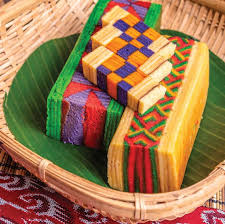

The recipe for the Kek Lapis Sarawak is very similar to the lapis legit, using western baking methods with the typical butter, sugar, eggs etc. However, the spices used in lapis legit may be omitted or altered to suit the different flavors. There is one more major distinction between the Sarawak cakes and the Indonesian delicacy – presentation.
To me, it’s like magic. Opening up a kek lapis and finding the intricate design so carefully hand crafted, carrying with it, generations of cooking, passion and culture. Just like any magic trick, sometimes it’s better not to reveal all the secrets. However – in very simple terms – kek lapis is made even more meticulously than the lapis legit to create these “geometricly” (not a real word) satisfying artistry inside. Bakers use strips of square, rectangular, triangular or pattern (polka dot) cuts of cake to create various kaleidescopic (not a real word either!) designs. Layer by layer, they place delicate strips on top of each other – a laborious and patient task. Drizzles of jam or condensed milk acts as a glue to the cake before being pressed down to finish off the layer. Thus, the bakers create many colors and flavors of kek lapis, cutting them into various shapes to show off the geometric cake baking inside. It is a kuih that is extremely difficult to cook at home due to how time consuming the process is and the need for specific ovens, knives and other kitchen utensils.
From early kue making in Indonesia to today’s funky flavors of kek lapis sarawak, the layer cakes of South East Asia have been constantly evolving. However, the evolution did not stop in the archipelago. As travelers, traders and colonizers came and left, it brought new, similar desserts across the seas and oceans where other cultures enjoy similar treats. From Chaoshan to Timor Leste to Goa, these fusion treats show up in more places than you may initially think.
Some Authentic Recipes to Learn From
- Kue lapis recipe – https://youtu.be/d3gYeAP5DwE?si=trUbdITdPzOHHy-t
- Kek Lapis Sarawak recipe – https://www.houseofannie.com/making-sarawak-layer-cake/
- Lapis Legit recipe – https://whattocooktoday.com/lapis-legit-prune-thousand-layer-cake-spekkoek.html
- https://www.mykeuken.com/2011/03/kuih-lapis-steamed-rice-flour-layers.html?m=1
- https://artsandculture.google.com/story/cinnamon-the-soul-of-sweets-indonesia-gastronomy-network/ZgVxN2tG11t5og?hl=en
- https://indomedieval.medium.com/why-are-there-more-references-to-clove-and-nutmeg-in-medieval-european-texts-than-in-old-javanese-ea0d85a760d8
- https://www.freemalaysiatoday.com/category/leisure/2018/10/14/kek-lapis-saluting-its-sweet-heritage
- https://biblioasia.nlb.gov.sg/vol-16/issue-4/jan-mar-2021/kueh-lapis/#:~:text=The%20oldest%20spekkoek%20recipe%20I,equal%20prosperity%2C%E2%80%9D%20says%20Soemantri.
- https://biblioasia.nlb.gov.sg/vol-16/issue-4/jan-mar-2021/kueh-lapis/#fn:2
- https://kwgls.wordpress.com/2013/11/20/not-a-lapis-legit-but-a-rich-dense-lapislapis-horlicks-horlicks-layered-cake/
- https://www.anncoojournal.com/wp-content/uploads/2013/01/kuih-lapis-steamed-layer-cake-035.jpg
- https://blogger.googleusercontent.com/img/b/R29vZ2xl/AVvXsEhFNCziuojqboUysxmV_Ris2CNZ1QEi9IEFxanCq0vlqoa39xDcF2P5lw4O_UL7z5PXbfPi6vuG2N8xDwxlKHMaV_hcwUqasoeEHlKhZV1ppNhNrmrg7w4uNQa1CPZI-kg895vK1Sl8P1j4/s1600/Kue_lapis_tiga_warna-0301.jpg


